
LOUVRE HISTORY, COLLECTIONS AND FACTS
The story behind the Louvre
The Louvre Museum is the world’s most-visited art museum, a famous landmark and historical monument in Paris. It serves as France’s national museum and art gallery. Located within a section of a grand Renaissance palace, it was built in the 12th century on the right bank of the Seine River. Initially, it was the defensive fortress of Philip Augustus.
Historically, the Louvre has always been associated with the power and representation of the French state. Today, the Louvre symbolizes French art and culture, displaying an impressive collection from ancient art to the mid-19th century.

Built as a defensive castle in the 12th century
The Louvre was first built as a castle and a fortress by King Philip II of France around 1190 to defend and protect Paris from possible invaders. The castle was designed to enforce the western front of the Wall of Philip II Augustus, marking the city’s boundaries. It had an important role in the defense of Paris during the late 12th century.
Royal Residence
In the 16th century, the Louvre was mainly used as a royal residence for several French monarchs. King Henry II hosted many events in the palace with his wife, Catherine de’ Medici. Throughout its history, besides being used as a French royal residence at various times between the 14th century and 18th century, the Louvre has also been used for multiple government functions.

Royal additions in the 17th century
During the 17th century, Louis XIII and Louis XIV made significant additions to the building, increasing its size and connecting it to the Tuileries Palace. The museum also started to build its extensive art collection with significant additions from Cardinal de Richelieu and Louis XIV’s minister, Cardinal Mazarin. By the end of the century, the Louvre was becoming recognized as both a royal residence and a cultural institution.
From a royal residence to a public museum
In the 18th century, the idea of turning the Louvre into a public museum started to gain popularity. The Musée Central des Arts was opened to the public in 1793 during the French Revolution. During the 18th century, the Louvre was redesigned to fit better into its new role as a museum. Napoleon Bonaparte initiated extensive renovations and added new wings to display more pieces of art.

19th-century expansion
In the period after the French Revolution, the Louvre became a public museum. Napoleon III continued with the expansion of the museum and improved its collections. By the end of the 19th century, the Louvre established itself as a major cultural landmark that exhibited a large collection of art from many different periods and regions.
20th-century modernization
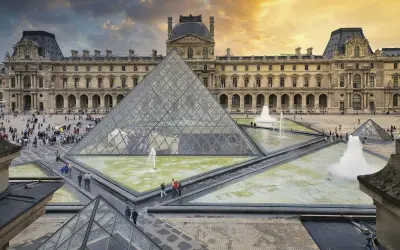
In the 1980s and 90s, the Louvre was renovated to improve accessibility. An underground section was built, which included various shops, office spaces, and a cafeteria. Also, in 1989, an iconic glass pyramid entrance was added. These changes combined contemporary design with the historic palace, making the museum more open and approachable.

The Louvre Pyramid
The Louvre Pyramid was created during the Grand Louvre project in the 1980s to modernize the museum and assist visitors with easier access. Created by Chinese-American architect I.M. Pei, the pyramid stands at the entrance to the historic palace, connecting the museum’s history with the present.
200th anniversary
The Louvre marked its 200th anniversary as a public museum in 1993. The new Richelieu Wing also opened to present a large collection of European paintings and other artworks.

Current Collections
The Louvre has one of the largest painting collections in the world, featuring European art up to the Revolutions of 1848. It houses eight main departments. The Grande Galerie is a prominent part of the Louvre, exhibiting mostly Italian masterpieces. The museum also includes a collection of Greek, Etruscan, Roman, and Egyptian antiquities, Islamic Arts, and Near Eastern antiquities in other sections.
Some highlights include French paintings from the 15th to 19th century and iconic masterpieces like the Mona Lisa, The Raft of the Medusa, The Winged Victory of Samothrace, and The Venus de Milo. With our Louvre Small-Group Tour, you can explore the famous art pieces across the museum with an expert guide.

Famous Mona Lisa
The Mona Lisa, created by Leonardo da Vinci between 1503 and 1519, is one of the world’s most famous and valuable artworks, with the Guinness World Record for the highest insurance value for a painting. Over the years, the painting has survived theft, damage, and evacuations during the wars.
With her mysterious smile, Mona Lisa continues to inspire artists to this day and is one of the world’s most viewed artworks, attracting millions of visitors to the Louvre. Because of its popularity, it is displayed behind bulletproof protective glass in the Louvre’s largest room, the Salle des États. You can see the famous Mona Lisa with direct access and a host to bypass the crowds with our Mona Lisa Tickets.
Want to learn more about the Louvre’s history?

Expert guide
Louvre Small-Group Tour
Join our guided tour for an unforgettable visit to one of the world’s most famous museums. See iconic artworks like the Mona Lisa, Venus de Milo, and Winged Victory of Samothrace. Learn about the modern Louvre Pyramid at the museum entrance and explore the valuable art collections. With a knowledgeable guide, you’ll hear interesting stories about the artists and their works. Your expert guide will assist you in navigating the large museum, ensuring you find the most famous pieces without getting lost.

Avoid midday crowds
Louvre Night Tour
Discover the Louvre's most famous artworks on a last-entry tour led by an expert guide. Enjoy the rare opportunity to view Leonardo da Vinci's Mona Lisa without the crowds, and take your time appreciating its beauty. Your professional guide will take you to see the most exciting art pieces in different sections of the museum and will share stories about each one. Louvre Night Tour offers a chance to enjoy the stunning architecture and art in a peaceful and relaxing atmosphere. With a small group, you can fully enjoy the various artworks without the stress of having to navigate the museum by yourself.