
LOUVRE ARCHITECTURE
The Louvre’s architectural journey
The architecture of the Louvre reflects centuries of development and change. Originally built as a fortress in the 12th century, it gradually became a royal palace. Many architects contributed to its design, blending styles from Medieval, French Baroque, Renaissance, Neoclassical, and Modern periods.
Covering 60,600 square meters, the Louvre Palace is a vast complex of pavilions and wings on four main levels. While it looks unified, its current appearance results from many phases of construction, renovations, and restorations over the centuries. Constructed over five centuries, the Louvre began as a small piece of land along the Seine River outside Paris. Its gradual transformation into a grand museum shows the rich history of the site and the influence of various architectural styles throughout its long history.

12th & 13th century: The Romanesque castle and military stronghold
The first Louvre was built as a medieval Romanesque fortress with thick walls constructed to protect the western boundaries from foreign invasions. During the rule of King Philippe Auguste II in 1190, a fortress was constructed with small windows, high walls, and ten round defensive towers to provide security and defense against potential threats. The initial Louvre was almost square (78×72 meters), surrounded by a thick wall (2.6 meters) and a water-filled moat. The well-preserved remains of the medieval foundation still exist and can be viewed on the Louvre’s ground floor in the Sully Wing. In 1230, during the rule of Louis IX, a chapel and the main ceremonial room (Grande Salle) were added.

14th & 15th century: Fortress and Royal Residence
During the 14th and 15th centuries, there were no significant developments in the Louvre, except for a period of rule by Charles V. In 1364, he decided to move to the Louvre and make it his royal residence. His architect, Raymond du Temple, extended the palace and added new decorations and windows. During the 15th century, the Louvre was mainly used as an arsenal and prison.

16th century: A Renaissance palace
In 1528, Francis I built a new Renaissance architecture building on the site. Architect Pierre Lescot and sculptor Jean Goujon were hired to design the Lescot wing with a grand staircase. Pierre Lescot was among the first to use classical design in France, and his unique double-pitched mansard roof inspired many 18th-century buildings in France and around the world.
In 1564, Catherine de Medici commissioned her architect Philibert Delorme to build a little castle in a neighboring field on the west called Tuileries, with plans to connect it to the Louvre. During the rule of Henry V, the Grande Galerie, which is 460 meters long with lavishly decorated rooms for royal portraits, was added.
17th century: French Baroque extensions
In the 17th century, Louis XIII expanded the Louvre with the Pavillon de l’Horloge, designed by Jacques Lemercier. The northern wing and the Galerie d’Apollon were also built in the French Baroque style, known for their intricate details and bold and dramatic style.
Ready to explore the masterpieces inside the Louvre Museum?

Reserved access
Louvre Museum Ticket
Enjoy access to the Louvre Museum with the timed entry ticket. Explore art history and famous collections at your own pace. Walk through the corridors of one of the world’s most famous museums, visited by millions. See masterpieces like the Mona Lisa, Venus de Milo, Winged Victory, and many others. With over 35,000 pieces in eight sections, the Louvre offers an unforgettable journey through the history of art and culture.

See Mona Lisa before anyone else
Mona Lisa Ticket
Visit the Louvre Museum and go straight to the famous Mona Lisa painting with your host. Enjoy your time-reserved direct access to Leonardo's iconic painting, attracting millions of visitors annually. Enjoy seeing Mona Lisa's enigmatic smile and discover for yourself why this painting is one of the most recognized artworks in the world. Beyond the Mona Lisa, explore other valuable art collections and masterpieces displayed in the Louvre.

18th century Neoclassicism
After the royal court moved to Versailles in 1682, the Louvre changed its use and architecture. Various tenants, including artists, moved in, each with their own style. Architect Jacques-Germain Soufflot used French Neoclassicism in his renovations, focusing on grandeur and order. During the 1790s, during the turbulent times of the French Revolution, most of the royal court members left, and more artists started coming to the Louvre, which resulted in further architectural changes.

19th century: Napoleon’s Vision
The transformation and restorations in the Louvre continued during the 19th century when Napoleon appointed Pierre Fontaine and Charles Percier to work on redesigning the Louvre. They transformed the Louvre in Neoclassical and French Empire style. The Grand Entrance was created with Napoleon’s large bronze head. The Richelieu Wing was also added to accommodate the growing collection of artworks. Under Napoleon III, Hector Lefuel expanded the Louvre, connecting it to the Tuileries, and created the “Nouveau Louvre”, completed in 1857. The Tuileries Palace was destroyed by fire in 1871, but the Louvre itself was preserved.

20th century: Louvre’s Pyramid
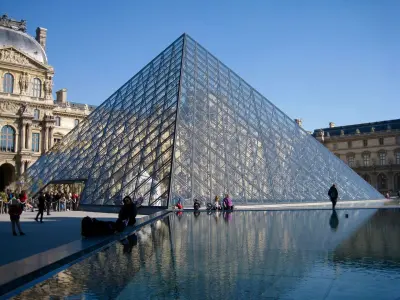
In the 20th century, the Louvre underwent major changes, with the Grand Louvre project started by French President François Mitterrand in the 1980s. The most famous addition was the glass pyramid by Chinese-American architect I M Pei, which was officially revealed on 29 March 1989. This modernist structure improved visitor access and connected the old and new styles. The project also expanded the underground lobby and other facilities like exhibition spaces and a shopping mall. Although its proposed modern design was controversial in the beginning, it has since become accepted as a successful modernist addition to the classical architectural style of the Louvre.
Made out of steel and glass, it stands 20.6 meters tall with a square base of 35 meters. Its nearly 700 glass panes allow light into the space below the Cour Napoléon. Surrounding the main pyramid are three smaller glass inverted pyramids that provide light to the underground spaces of the Louvre.
Louvre today
Today, the Louvre’s architecture shows a harmonious blend of historic and modern elements, combining classical and contemporary designs. The Louvre Pyramid at the entrance symbolizes the museum’s evolution. The complex’s vast structure of wings and pavilions reflects centuries of construction, restoration, and adaptation.
Want to find out more about the Louvre and its architecture?

Expert guide
Louvre Small-Group Tour
Join our guided tour for an unforgettable visit to one of the world’s most famous museums. See iconic artworks like the Mona Lisa, Venus de Milo, and Winged Victory of Samothrace. Learn about the modern Louvre Pyramid at the museum entrance and explore the valuable art collections. With a knowledgeable guide, you’ll hear interesting stories about the artists and their works. Your expert guide will assist you in navigating the large museum, ensuring you find the most famous pieces without getting lost.

Avoid midday crowds
Louvre Night Tour
Discover the Louvre's most famous artworks on a last-entry tour led by an expert guide. Enjoy the rare opportunity to view Leonardo da Vinci's Mona Lisa without the crowds, and take your time appreciating its beauty. Your professional guide will take you to see the most exciting art pieces in different sections of the museum and will share stories about each one. Louvre Night Tour offers a chance to enjoy the stunning architecture and art in a peaceful and relaxing atmosphere. With a small group, you can fully enjoy the various artworks without the stress of having to navigate the museum by yourself.